One way to improve kindergarten attendance: Take the school bus
 Credit: Chez_Sugi, Creative Commons
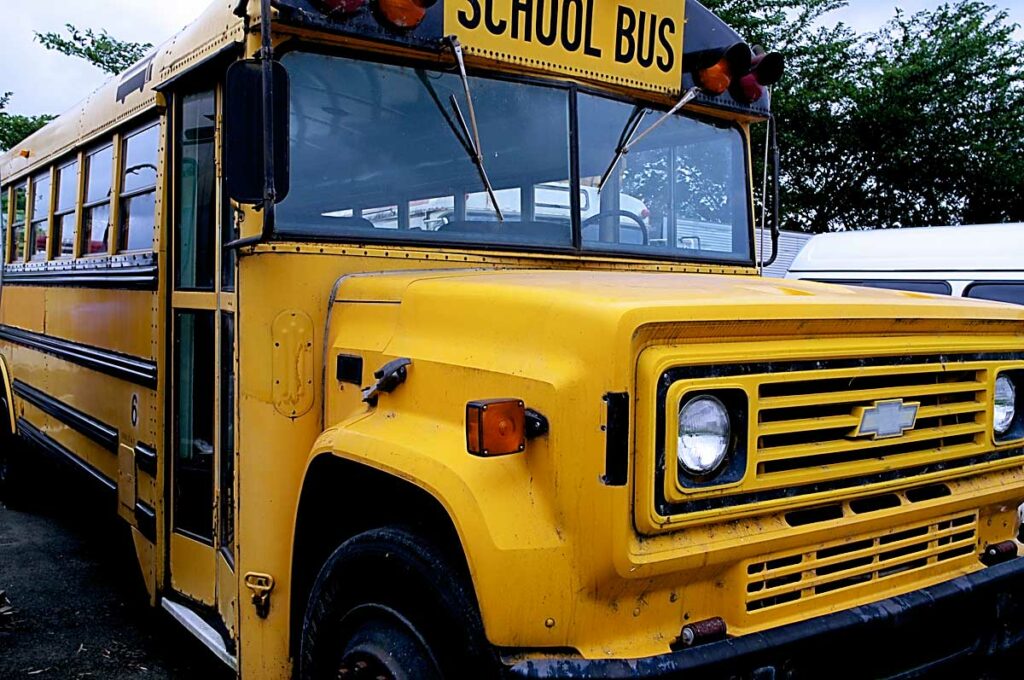 Credit: Chez_Sugi, Creative Eatables
Hop on the passenger vehicle, Gus.
Students who ride the school bus in the critical first yr of formal didactics – kindergarten – are absent-minded less often and have lower odds of being chronically absent, a primal indicator of future academic success, according to a new study.
The "school bus effect" improves kindergarten omnipresence in families of all income levels, said UC Santa Barbara professor Michael Gottfried, who conducted the study in partnership with the Truancy Reduction Pilot Projects initiative of California Attorney General Kamala Harris. The unpublished study, "Linking Getting to School with Going to School," used a nationally representative sample of fourteen,000 kindergartners drawn from U.Southward. Section of Education data. It is believed to be the first to quantify the result of school bus transportation on chronic absenteeism.
Kindergarten was one time considered past some to be a relatively insignificant grade level – it is still not mandatory in California until age six. Simply as the heft of kindergarten curricular offerings has increased, then have the ramifications of missing formative instruction. Research has linked chronic absenteeism in kindergarten – defined as missing x percent or more of school days – to lower achievement in futurity grades in math and reading, an increment in problem beliefs and difficulty in obtaining a score of "proficient" on California'due south tertiary-class reading examination. In plough, students who struggle with reading in 3rd grade are less likely to graduate from high school on fourth dimension.
"We know what factors contribute to chronic absenteeism," said Gottfried, who presented his findings at a Sacramento event last month hosted by the nonpartisan enquiry group Policy Analysis for California Pedagogy. (See his presentation here. The school motorcoach research begins at 45:51.) He reeled off a list of factors that keep students out of school, including untreated asthma, boredom with classroom instruction, suspensions and bullying. Simply, he said, "we don't have a lot of inquiry on what to practice and how to intervene."
His partnership with the attorney general is an attempt to identify and examination interventions that could be replicated in school districts across the land, he said.
The positive results of the school bus study surface against the backdrop of California's dwindling school bus transportation organization, which transports one in eight students, downwards from one in iv in the late 1970s. State funding for transportation is locked at early on 1980s reimbursement rates, co-ordinate to a 2022 report from the Legislative Analyst'southward Office, and some districts accuse parents fees for motorbus service, including the San Diego Unified Schoolhouse Commune, which charges $500 per school yr for one pupil, $250 for a sibling and no additional charge for other siblings. Other districts accept decided to no longer offer a motorcoach service except for students with disabilities, a change Long Beach Unified School District volition make beginning in 2016-17, a district spokesman said.
The study highlighted the potential effectiveness of addressing the logistics of getting students to schoolhouse, which include lack of jitney fare, cars that don't work and unsafe routes. Dan Sackheim, an educational options consultant for the California Department of Education, co-leads attendance workshops for educators that address a range of issues – Are administrators telling parents that attendance is crucial to academic success? Practise students experience prophylactic and welcomed at schools? Sackheim attended Gottfried'southward presentation.
"I hadn't been thinking of schoolhouse buses," he said.
Riding the school bus has the most positive issue – a twenty percent increase in kindergarten omnipresence – in families where the female parent doesn't piece of work, the travel fourth dimension to school is greater than average or the student has not attended preschool, Gottfried said.
"Kindergarten is a big shock to the family system," Gottfried said, peculiarly if the child hasn't attended preschool, which he called "boot campsite, not but for the kids, but for the parents." As an aside, Gottfried mentioned that in an before study, he institute that attention preschool reduced chronic absenteeism, a result he attributed to families overcoming the same logistical and emotional challenges that first-fourth dimension kindergarten families confront.
Entering kindergarten is a time "total to the skirt with transitions," Gottfried said, and transitions create stress. The kid needs to be awakened, dressed, fed, equipped with a tiffin and transported to school past a sure time. The parent has to manage the new routine – and some days get more smoothly than others. Stressed parents create stressed children, he said, and stressed children sometimes balk at going to school.
In families where ane parent is not working and is staying dwelling house, peradventure with a younger child, information technology tin can seem only as piece of cake to go along the kindergartner at home, Gottfried speculated. Working parents, in dissimilarity, are leaving the house anyway.
The lumbering yellow school double-decker provides a structure, Gottfried theorized. "If parents are new at this, or uncertain, here is something that shows up every day at your door at 7 o'clock, or every day at the corner at 7:30 – same identify, aforementioned fourth dimension, every day."
Withal logistical support doesn't have to crave a school bus, he said. "How can we induce the 'schoolhouse motorcoach effect' when at that place is not a school bus in the commune?" he asked.
Gottfried's research will continue for the adjacent several months to explore other possible interventions. Pilot intervention tests, which are funded by foundation grants, could whorl out in iii districts in Northern, Central and Southern California in 2016-17, he said.
Nationwide, 10 percentage of kindergartners miss more than 10 percentage of school, while an boosted 14 percent of kindergartners are just shy of being chronically absent, Gottfried said. In California, kindergartners are the most probable of any simple students to be chronically absent, according to the 2022 In School + On Track absence report past Harris. In the report, Harris stated, "It is a solvable problem."
To become more than reports like this one, click here to sign up for EdSource's no-cost daily email on latest developments in didactics.
Source: https://edsource.org/2016/one-way-to-improve-kindergarten-attendance-take-the-school-bus/94304
0 Response to "One way to improve kindergarten attendance: Take the school bus"
Post a Comment